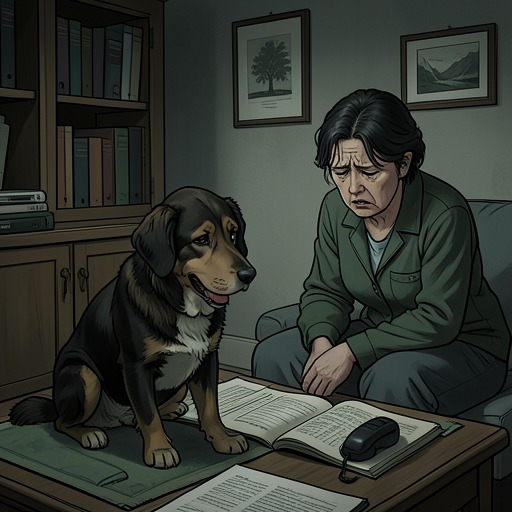
Bella receives an emotional support animal certificate
A Dog's Way HomeBella receives an emotional support animal certificate through a document that recognizes her support for Terri without certifying her as a trained seizure-alert dog. The distinction matters: Bella’s warning behavior is natural rather than formally trained, but a physician’s letter gives Lucas a possible way to keep her at home despite the apartment’s no-pets rule. The episode turns Bella’s informal acts of care into a question of medical description, housing access, and institutional permission.
Bella’s care at the hospital
Before the letter is issued, Bella has already been brought into new rooms at the VA hospital, where people sit in chairs and welcome her. Patients pet her and call her by name; among them are older people as well as others. Ty takes her around the room, and people offer her food. The scene establishes that her presence is not confined to Terri’s needs: she draws attention and affection from a wider group of patients.
Ty also introduces Bella to Mack, who sits alone in a broad chair by a window. Bella reads his sadness as resembling the despair she remembers in Terri. She climbs up beside him, and Mack holds her for a long time. The encounter gives Ty’s later defense of Bella a concrete basis in the story: her help is shown through people responding to her presence, not through a formal clinical role.
Seizure warnings and the limits of certification
At home, Lucas looks up information on his phone and tells Terri that some dogs can sense seizures. Terri agrees that Bella seemed to know what was happening. Lucas then reports that Bella has barked on both recent occasions when Terri was going into a seizure. He believes that if they understood the warning, they might be able to prepare. The account presents this as an observed behavior and a family’s interpretation of it, not as proof that Bella has been trained or medically certified to alert.
When Lucas and Ty discuss the matter with a physician, the physician explains that seizure dogs exist and that many are trained to signal. He also says that, under the process he describes, a dog must be certified and a doctor must prescribe the accommodation. Bella, at this point, is still regarded as a pet. The physician will not state that she is a trained seizure-alert animal: her ability is innate, and she has not received that training. The answer blocks the specific certificate Lucas first hopes to obtain, even though the family’s account of her warnings remains unchanged.
Ty’s case and the physician’s letter
Ty argues for Bella on grounds beyond seizure detection. He tells the physician that she reduces stress on the ward and is welcomed by people in the twelve-step program. Participants are glad to have her there; those who want to speak often pet her first. Ty also reports that Terri considers Bella more effective than the antidepressants she takes. These are Ty’s observations and Terri’s reported experience, offered to show the physician the practical value of Bella’s presence.
The discussion exposes a second institutional obstacle: dogs are not permitted at the VA hospital. Ty acknowledges the rule but insists that Bella makes a difference to the veterans and other patients he cares about. The physician initially distinguishes that advocacy from what he can formally certify. He cannot provide documentation identifying Bella as a seizure dog, but he says his understanding of the Fair Housing Act is that an emotional support animal can be recognized with a letter from a doctor currently treating the person who needs the support. He agrees to write that letter for Terri.
The document and its consequences
Lucas asks whether the letter will allow the household to remain in the apartment. The physician is careful not to offer a legal guarantee, but says what he has read appears to indicate that the building must make an exception. The qualification matters: the document gives Lucas grounds for hope, not a fully resolved legal outcome. The immediate change is that he leaves with a piece of paper and appears very happy, though he celebrates without giving Bella a treat.
Afterward, the routine at home changes. Lucas no longer steps outside briefly before bringing Bella to the sidewalk; they leave together, and he lets her sniff and linger near the front door. This small shift suggests that the letter alters how he manages her presence around the building. It also gives the event its larger significance: Bella’s care was already legible to people who welcomed her, but housing and workplace rules require that care to be translated into an officially recognized status. The physician’s letter does not certify every ability attributed to Bella or erase the hospital’s restrictions. It does, however, provide a practical route for recognizing her role with Terri while preserving the difference between an innate warning behavior and trained medical service.